

06.08.2026 - DC Download
The House is set to take up the immigration enforcement reconciliation bill, along with a trio of “fraud prevention” measures that could dramatically expand federal data collection and payment delays. Meanwhile, lawmakers are running out of time to reauthorize the government’s surveillance powers after a failed vote in the Senate, and there’s a new bipartisan AI regulation proposal hitting Congress.
Progressive Playbook
Progress for the People Town Hall Comes to Bethlehem, PA!
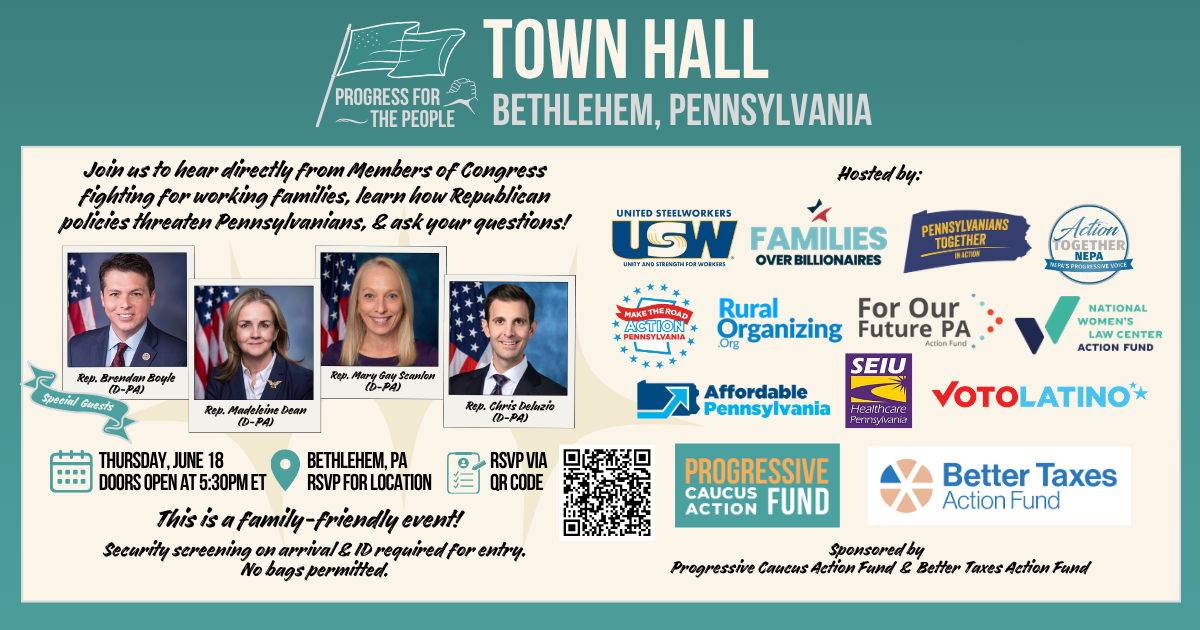
The Progress for the People Town Hall comes to Bethlehem, Pennsylvania on Thursday, June 18, 2026 at 5:30 PM ET. Hear from national progressive leaders and local advocates as they lay out a more just, equitable vision for the country — and bring your questions!
RSVP today to join us and be part of the conversation!
House
House Floor
The House will vote on 19 suspension bills from the Committees on Foreign Affairs and Oversight and Government Reform. Suspension bills require a ⅔ majority to pass. For a list of all suspension bills being considered, click here.
This week the House will also consider the following bills, subject to a rule:
S. 2 – Secure America Act (Sponsored by Sen. Graham – Budget Committee)This bill is Republicans’ budget reconciliation package to fund the Trump administration’s immigration enforcement agenda through the rest of Trump’s term. After a months-long Department of Homeland Security (DHS) shutdown, Republicans split off Immigration and Customs Enforcement (ICE) and Customs and Border Patrol (CBP) funding and moved it through reconciliation, allowing them to pass tens of billions of dollars for immigration enforcement on a party-line basis instead of negotiating accountability measures through the regular appropriations process.
Last Friday, the Senate passed S. 2 after an all-night vote-a-rama, with only one Republican voting no. The bill would provide $69.5 billion for ICE, CBP, and DHS, on top of the $170 billion Republicans already delivered through last summer’s “One Big Beautiful Bill Act.” It includes $38.5 billion for ICE, $26 billion for CBP, and $5 billion for DHS to hire more agents, expand deportation operations, buy new surveillance technology, and deepen coordination with state and local law enforcement. It also includes a $350 million ICE enforcement fund aimed at jurisdictions the administration labels “non-cooperating,” giving the White House another tool to target cities and states that refuse to help carry out its mass deportation agenda.
Despite Being Flush in Cash, DHS Wants $70 Billion More in Tax Payer Dollars (NILC)
Senate Republicans pass immigration funding after overnight vote (NPR)
What’s at stake for children in reconciliation and budget decisions (First Focus on Children)
H.R. 8312 – Fraud Prevention and Accountability Act (Sponsored by Rep. Comer – Oversight and Government Reform Committee) This bill would dramatically expand the Treasury Department's Do Not Pay database to include sensitive personal information from agencies across the federal government, effectively creating a master database on all Americans that every agency would be required to screen payments against before disbursing funds.
CDT Opposes Two Bills, H.R. 8312 and H.R. 8464, That Threaten Personal Privacy from the Federal Government (Center for Democracy and Technology)
H.R. 8464 – Stopping Fraudulent Payments Act (Sponsored by Rep. Sessions – Oversight and Government Reform Committee) This bill would give the Treasury Department new authority to pause any federal payment it determines presents an "elevated risk" of fraud, based on a definition broad enough to cover a wide range of payments across federal programs. Critics warn this gives Treasury a tool to withhold lawfully appropriated funds with little accountability.
CDT Opposes Two Bills, H.R. 8312 and H.R. 8464, That Threaten Personal Privacy from the Federal Government(Center for Democracy and Technology)
H. Res. 1335 – Condemning actors seeking to defraud the United States Government, and expressing the sense of the House of Representatives that government-wide fraud and improper payment prevention reforms will meaningfully improve the financial prosperity of the United States, and that Federal program eligibility should be verified before payment (Sponsored by Rep. Fallon – Oversight and Government Reform Committee) This non-binding resolution expresses the sense of the House that fraud prevention reforms will improve the country's fiscal health and that eligibility for federal programs should be verified before payment is made. It is a political companion to H.R. 8312 and H.R. 8464, designed to put Members on-record in support of the broader package ahead of floor votes.
H.R. 7892 – No Aid for Ghost Students Act of 2026 (Sponsored by Rep. Owens - Education and Workforce Committee) This bill would require the Department of Education to use an identity fraud detection system to screen every FAFSA application and withhold federal financial aid disbursement from any applicant flagged for suspected identity fraud until their identity is verified by their institution.
The Hidden Power Grab in “Fraud Prevention”—and the Students Who Will Pay (Temple University, the Hope Center for Student Basic Needs)
Possible Consideration of Democrat Discharge Petition H. Res. 1140 – Providing for consideration of the bill (H.R. 5408) to accelerate workplace time-to-contract under the National Labor Relations Act. (Sponsored by Rep. Norcross – Rules Committee)This bill would require employers to begin negotiating with a newly certified union within 10 days, trigger federal mediation if no agreement is reached after 90 days, and send unresolved disputes to binding arbitration. Workers currently wait an average of 458 days for a first contract after voting to unionize.
Rep. Norcross Files Discharge Petition for Bipartisan Bill to Speed Up First Contracts for New Unions (Rep. Donald Norcross)
AFL-CIO Letter Supporting Legislation That Would Lead to Wide-Ranging, Pro-Worker Labor Law Reform (AFL-CIO)
House Committee Highlights
A full list of this week’s hearings and markups can be found here. Notable hearings and markups include:
Tuesday Hearings
Converging Criminal Enterprises: Chinese Money Laundering Networks and Cartel Financing in the U.S. Financial System (Committee on Financial Services)
The Southern Poverty Law Center: Manufacturing Hate, Part II (Committee on the Judiciary)
On Call for America: Strengthening Access Through Locum Tenens Providers (Committee on Education and Workforce)
Full Committee Legislative Hearing on Digital Asset Taxation (Committee on Ways and Means)
Wednesday Hearings
Agricultural Perspectives on the Future of the USMCA (Committee on Agriculture)
An Overview of the Department of Energy’s Fiscal Year 2027 Budget Request (Committee on Science, Space, and Technology)
Secretary of Energy Christopher Wright testifying
Examining Local Needs in Disaster Recovery (Committee on Financial Services)
Preventing Fraudulent Donations: Transparency, Verification, and Accountability (Committee on House Administration)
Joint Social Security and Work & Welfare Subcommittee Hearing with the Commissioner of Social Security, Frank J. Bisignano (Committee on Ways and Means)
Commissioner of Social Security, Frank J. Bisignano testifying
Breaking Trust: Attacks on Parental Rights, Inappropriate Content, and Legal Abuses in America’s Schools (Committee on Education and Workforce)
Lowering Health Care Costs for All Americans: Examining Policies to Increase Health Care Transparency (Committee on Energy and Commerce)
Senate
Nominations
The Senate this week has teed up votes on the following nominees:
Anthony W. Mattivi, of Kansas, to be United States District Judge for the District of Kansas.
Senate Committee Highlights
A full list of this week’s hearings and markups can be found here. Notable hearings and markups include:
Tuesday Hearings
The Need for Speed: How Technological Advances are Driving Transportation Innovation (Committee on Commerce, Science, and Transportation)
Wednesday Hearings
Closed Full Committee Markup of the National Defense Authorization Act for Fiscal Year 2027 (Committee on Armed Services)
Oversight hearing to examine the U.S. Department of Agriculture (Committee on Agriculture, Nutrition, and Forestry)
AI and the American Dream: Promoting Innovation, Affordability, and American Dominance (Committee on Banking, Housing, and Urban Affairs)
Issues to Watch
Congress’ latest attempt to regulate AI
Last Friday, Reps. Jay Obernolte (R-CA) and Lori Trahan (D-MA) released the Great American AI Act, a bipartisan discussion draft to create a federal framework regulating artificial intelligence. The draft, which has not yet been formally introduced, would set rules around powerful AI systems, introducing safety review and federal reporting on workforce impacts. But its biggest flashpoint is a three-year preemption of state laws regulating AI development, which critics argue would overturn existing laws and tie states’ hands just as they are moving to protect workers, consumers, and communities from AI harms.
That concern has already drawn opposition from labor and consumer advocates. Critics argue the draft leaves major issues like algorithmic discrimination, employment discrimination, consumer fraud, deepfake exploitation, and market concentration largely unaddressed. Supporters, including major tech industry voices, argue Congress needs a single national standard governing AI. For now, the draft is just that: a draft, and supporters say they are open to feedback. But the early reaction shows the coming fight will not simply be over whether Congress acts on AI, but whether federal action becomes a floor for protections or a ceiling that preempts stronger state action.
Union Leaders Urge Congress to Reject the Great American AI Act
ACLU Opposes Preemption Language in Great American AI Act (GAAIA) Draft Bill
FISA renewal thrown into doubt after Trump intelligence pick
Congress is once again staring down a Thursday deadline to renew Section 702 of the Foreign Intelligence Surveillance Act (FISA), the warrantless surveillance authority that allows U.S. intelligence agencies to collect the data of “non-U.S. persons” (non-U.S. citizens or residents) abroad. Section 702 allows for the data of U.S. persons to get swept up “incidently.” Supporters argue the program is essential to national security, while civil liberties advocates have long warned that it also sweeps in Americans' data and has been used to spy on protesters, journalists, and ordinary people with little transparency or accountability.
After relying on a series of short-term extensions, congressional leaders reached an agreement on a three-year reauthorization of Section 702 that included some modest changes, but nothing to address the fundamental problem of warrantless data searches. Nonetheless, last Friday, the Senate blocked a procedural motion that would have set up a final vote on the deal. The failed vote came just days after President Trump named Bill Pulte, the head of the Federal Housing Finance Agency and a political loyalist with no national security experience, to serve as acting Director of National Intelligence. Bipartisan opposition to handing Pulte sweeping surveillance authorities tanked the vote 47-52. Senate leaders are expected to try again this week, but unless Trump reverses course, the path to renewing Section 702 before Friday looks increasingly narrow.
US lawmakers warn Pulte appointment could thwart surveillance law's renewal (Reuters)
Section 702 of the Foreign Intelligence Surveillance Act (FISA): 2026 Resource Page (Brennan Center)
What We’re Reading
Sharp Drop in Number of Children Receiving SNAP Food Assistance Under New Federal Law (Center on Budget and Policy Priorities)
Georgia town’s novel strategy to fight ICE jail plan impresses legal experts (Guardian)
Unions Build Wealth for All Americans (Center for American Progress)
What’s at Stake for Families as Federal Child Care Funding Faces Cuts (Georgetown Center on Poverty and Inequality)
GOP plots third reconciliation bill as midterm clock ticks (The Hill)
Key Dates
June 1 - June 30: Pride Month
June 15 - June 22: House in recess
June 19: Juneteenth
June 29 - July 10: Senate in recess
July 4: Independence Day