

06.22.2026 - DC Download
Congress is back this week with government funding bills on the House floor, an unresolved government surveillance authority standoff in the Senate, and a Supreme Court in its final stretch with major rulings still to come. Read on for this week's breakdown.
Progressive Playbook
Progress for the People Town Hall Heads to Racine, WI!
On Wednesday, July 8, 2026, the Progressive Caucus Action Fund is heading to Wisconsin for the next stop on the Progress for the People Town Hall Tour, a national series of community-led events focused on exposing the harms of the GOP budget law and building support for a future rooted in justice, equity, and accountability.
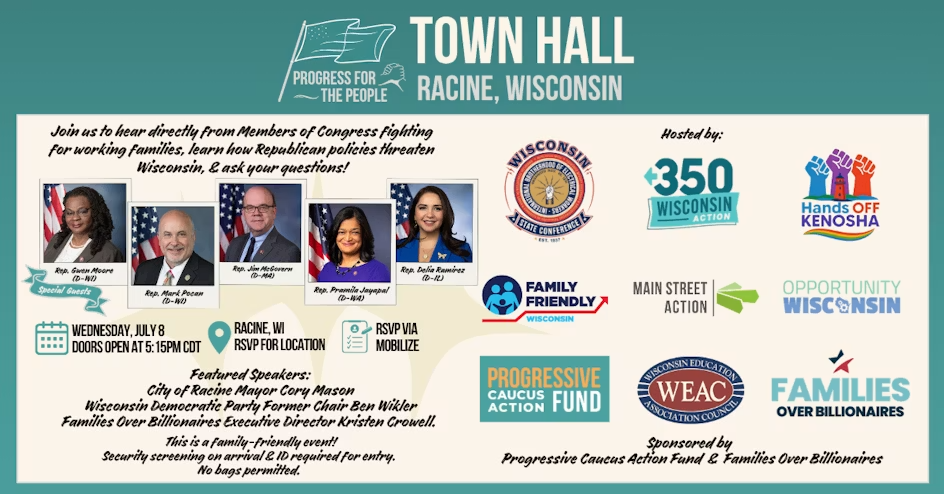
Join us in Racine, WI alongside local advocates, national progressive leaders, and our special guests: U.S. Representatives Gwen Moore (WI-04), Mark Pocan (WI-02), Jim McGovern (MA-02), Pramila Jayapal (WA-07), and Delia C. Ramirez (IL-03). Together, we'll hear how Republican policies are affecting communities and explore a bold vision for a stronger, fairer future.
When: Wednesday, July 8, 2026. Doors open at 5:15PM CDT
Who: 350 Wisconsin Action, Citizen Action of Wisconsin, Family Friendly Wisconsin, Families Over Billionaires, Hands Off Kenosha, IBEW Wisconsin State Conference, Main Street Action, Opportunity Wisconsin, and Wisconsin Education Association Council
RSVP today to join us and be part of the conversation!
House
House Floor
The House will vote on 11 suspension bills from the Committees on Small Business, Financial Services, and Agriculture. Suspension bills require a ⅔ majority to pass. For a list of all suspension bills being considered, click here.
This week the House will also consider the following bills, subject to a rule:
H.R. 8595 – National Security, Department of State, and Related Programs Appropriations Act, 2027 (Sponsored by Rep. Mario Diaz-Balart / Appropriations Committee): This bill provides $47.3 billion in discretionary funding for the Department of State and related programs for Fiscal Year (FY) 2027—$2.7 billion less than the previous fiscal year and 20 percent below FY 2025 levels. The bill also cuts critical diplomatic and humanitarian funding, threatening global health and women’s health programs, including HIV/AIDS prevention and treatment, maternal and child health, infectious disease response, and family planning, while also limiting funding to address the climate crisis and weakening U.S. engagement with international institutions and agreements.
Summary of House Republicans’ 2027 State, Foreign Operations, and Related Programs Bill (House Appropriations Committee Democrats)
State, Foreign Operations, and Related Programs Fiscal Year 2027 Fact Sheet (House Appropriations Committee Democrats)
H.R. 9022 – Energy and Water Development and Related Agencies Appropriations Act, 2027 (Sponsored by Rep. Chuck Fleischmann / Appropriations Committee): This bill provides $62.2 billion to the Energy Department, Army Corps of Engineers, and related agencies for FY 2027 — cutting nondefense programs by $1.8 billion, or 6 percent, from last year while boosting defense spending. The bill slashes clean energy and efficiency programs by 40 percent, claws back $2.8 billion in clean energy funds already allocated through the 2021 bipartisan infrastructure law, and eliminates funding to clean up radioactive contamination in communities left over from the nation's early atomic energy program. It also includes riders that block clean energy standards for federal buildings and allow firearms on Army Corps of Engineers public lands.
Summary of House Republicans’ 2027 Energy and Water Development, and Related Agencies Bill (House Appropriations Committee Democrats)
Fact Sheet of House Republicans’ Energy and Water Development and Related Agencies Fiscal Year 2027 Fact Sheet (House Appropriations Committee Democrats)
H.R. 9237 – Take Care of America’s Veterans Act (Sponsored by Rep. Mike Bost / Veterans’ Affairs Committee): This bill bundles more than 60 standalone veterans' bills into one package, including measures allowing combat-injured veterans to receive full military retirement pay and disability compensation simultaneously and expanding GI Bill eligibility to apprenticeship and online programs. However, the bill pays for those new benefits by cutting at least $60 billion from existing veterans' benefits. The bill also expands private, for-profit care at the VA while stripping collective bargaining rights from roughly 5,000 VA psychologists.
Ranking Member Takano Warns Against Republican Bid to Strip Veterans of Their Disability Benefits (House Committee on Veterans' Affairs Ranking Member Mark Takano)
Proposed "Veterans" Bill Would Betray Military Heroes and Workers Who Care For Them (AFGE)
Bill Meant to Aid Veterans Instead Betrays our Military Heroes and Federal Caregivers (AFGE)
H.R. 1181 – Protecting Privacy in Purchases Act(Sponsored by Rep. Riley Moore / Financial Services Committee): This bill prohibits credit card companies from assigning a specific merchant category code to gun retailers, overriding state laws in California, Colorado, and New York that require such coding. Removing this code eliminates a tool that helps financial institutions flag suspicious patterns of firearms purchases and report potentially illegal activity to law enforcement.
Additional legislative items are possible.
House Committee Highlights
A full list of this week’s hearings and markups can be found here. Notable hearings and markups include:
Wednesday Hearings
Safeguarding Federal Research Funds: The False Claims Act's Role in Combating Grant Fraud (Committee on Science, Space, and Technology)
The 30,000 Foot View: Competition and Regulation in the U.S. Airline Industry (Committee on the Judiciary)
Workforce Rewired: Modern Apprenticeships for a Modern Economy (Committee on Education and Workforce)
Failure at the Front Gate: Examining VA Police and Security Deficiencies (Committee on Veterans’ Affairs)
Thursday Hearings
Oversight Hearing – Department of Homeland Security (Committee on Appropriations)
Secretary of Homeland Security Markwayne Mullin testifying
Combating Waste, Fraud, and Abuse in SNAP (Committee on Oversight and Government Reform)
The Congressional Research Service and the Future of AI-Enabled Policy Analysis (Committee on House Administration)
False Narratives Surrounding Conditions at the Delaney Hall ICE Detention Center (Committee on the Judiciary)
From Wall Street to Main Street: The Future of How America Invests (Committee on Financial Services)
Senate
Senate Floor
The Senate will vote on the following legislation:
H.R.6644 – 21st Century ROAD to Housing Act(Sponsored by Rep. French Hill (AR) - Committee on Financial Services) This bipartisan bill expands tools for affordable housing construction, rural housing, manufactured housing, small-dollar mortgages, and voucher access, while also limiting large institutional investors from buying up single-family homes and outcompeting families.
H.Con.Res.86 – Directing the President, pursuant to section 5(c) of the War Powers Resolution, to remove United States Armed Forces from hostilities with Iran(Sponsored by Rep. Gregory Meeks (NY) - Committee on Foreign Affairs). This concurrent resolution directs the President to remove U.S. troops from hostilities with Iran unless Congress explicitly approves a declaration of war or otherwise authorizes military action.
Nominations
The Senate this week has teed up final votes on the following nominee:
Darrell Owens, to be Ambassador to the Organization for Security and Cooperation in Europe
Senate Committee Highlights
A full list of this week’s hearings and markups can be found here. Notable hearings and markups include:
Tuesday Hearings
Close Calls: Improving Safety Across the National Airspace System (Committee on Commerce, Science, and Transportation)
The Affordability Agenda (Committee on Banking, Housing, and Urban Affairs)
Wednesday Hearings
Reforming the U.S. Postal Service's Broken Business Model(Committee on Homeland Security and Governmental Affairs)
The Future of Social Security (Committee on Finance)
Protecting American Citizenship IV: America 250 and Reclaiming American Citizenship (Committee on the Judiciary)
Thursday Hearings
Full Committee Markup of Agriculture, Rural Development, FDA; Military Construction, Veterans Affairs, and Related Agencies Appropriations Act; Commerce, Justice, Science Appropriations Act; Legislative Branch Appropriations Act (Committee on Appropriations)
ISSUES TO WATCH
The Supreme Court's final stretch
The Supreme Court is entering the final stretch of its term, with several major decisions still outstanding. While the Court has already handed down significant rulings this year, it typically saves many of its most controversial opinions for the final weeks of June.
The biggest case to watch is the challenge to Trump’s executive order attacking birthright citizenship. If the Court allows the order to move forward, the consequences would be enormous: a president would have successfully claimed the power to narrow a constitutional guarantee by executive order, and the federal government could begin treating some children born in the United States as less American from birth.
The remaining cases could also have far-reaching implications for immigrant communities, transgender students, election rules, campaign finance, and the balance of power between Congress, the courts, and the executive branch. At the center of these cases is a bigger question about who the Constitution protects, who gets pushed out of public life, whose ballots count, and how much power this Court is willing to hand to Trump. Taken together, the remaining decisions will offer one of the clearest indicators yet of how aggressively the Court’s conservative majority intends to reshape civil rights, immigrant protections, democratic participation, and the constitutional limits on presidential power.
Trump revives voter suppression bill
The effort to advance the so-called “SAVE America Act” is back. Again. President Trump is demanding Republicans attach his marquee voter suppression bill to any reauthorization of Section 702 of the Foreign Intelligence Surveillance Act (FISA), the government's warrantless surveillance authority. The SAVE America Act would make it significantly harder for Americans to register and vote, all purportedly to prevent noncitizens voting in federal elections, something that is largely nonexistent and already illegal.
This is the latest move in Trump's yearlong campaign to force the bill through Congress: he’s called it his top legislative priority, vowed to refuse to sign any other legislation until it passed, tried to attach it to the reconciliation bill, and continues to pressure Senate Republicans to kill the filibusterto pass it. The House first passed a version in April 2025; when that stalled in the Senate, Republicans repackaged it as the more extreme SAVE America Act, which passed the House again in February 2026, only for the Senate to vote it down earlier this month.
Now FISA is the pressure point. Section 702 expired for the first time since 2008afterTrump tapped Bill Pulte, director of the Federal Housing Finance Agency with no intelligence experience, as acting Director of National Intelligence (DNI), triggering bipartisan opposition. That opposition looked likely to ease once Trump nominated Jay Clayton for the permanent DNI role and Senate Republicans moved to fast-track his confirmation. But then, Trump abruptly pulled Clayton's nomination and announced he would not support a FISA renewal unless Congress also advanced the SAVE America Act. Senate Majority Leader John Thune has again said Republicans don't have the votes, leaving the surveillance reauthorization in limbo and Trump's voter suppression push exactly where it's been all year.
The SAVE America Act Explained: How the New 'Show Your Papers' Voting Bill Is Even More Extreme Than the SAVE Act (Center for American Progress)
How the SAVE Act Threatens the Freedom to Vote (Campaign Legal Center)
SAVE Act Reaches Senate (Brennan Center)
What We’re Reading
House approves bill to speed up union contract negotiations (NPR)
What’s in Congress’s New ICE Funding Law? (National Immigration Law Center)
Extreme Heat is Killing America’s Workers (Groundwork Collaborative)
The Trump Administration Seeks to End Nonpartisan Grantmaking (Center on Budget and Policy Priorities)
Cooperation without Oversight: The United States–Israel Defense Technology Cooperation Initiative (Quincy Institute for Responsible Statecraft)
Trump Administration to Pay $765 Million to Cancel 4 More Wind Projects (New York Times)
KEY DATES
June 1 - June 30: LGBTQIA+ Pride Month
June 1 - June 30: Caribbean American Heritage Month
June 1 - June 30: National Immigrant Heritage Month
June 29 - July 10: Senate in recess
July 4: Independence Day
July 6 - July 10: House in recess