


We Pay, Billionaires Profit:
The Real Cost of Trump’s Tax Law
Last Updated: March 10, 2026
In July 2025, the Trump administration signed the “One Big Beautiful Bill Act” (OBBBA) into law creating the largest upward transfer of wealth from the working class to the rich in U.S. history. In fact, Yale’s Budget Lab found that the law will take money away from the bottom 40% of American households while the top 0.1% gain, on average, an extra $118,000. The legislation permanently extends the tax giveaways to corporations and the mega rich in the 2017 Tax Cuts and Jobs Act, increases funding of ICE tenfold, guts the clean energy provisions of the Inflation Reduction Act, kicks at least 17 million Americans off of their health care coverage, and increases the budget deficit by $2.8 trillion. This Republican budget law will harm working families and immigrant communities immediately and threaten the economy, healthcare system, and environment for all Americans.
Progressive Caucus Action Fund developed a tool to show what the Republican budget law means for ordinary American families. We created six household profiles representing families across the country to show how the law will reshape their finances, health care, jobs, safety, and futures. These profiles are composites, but their stories represent the very real impact on families and communities across the country.


TANIA, Minnesota
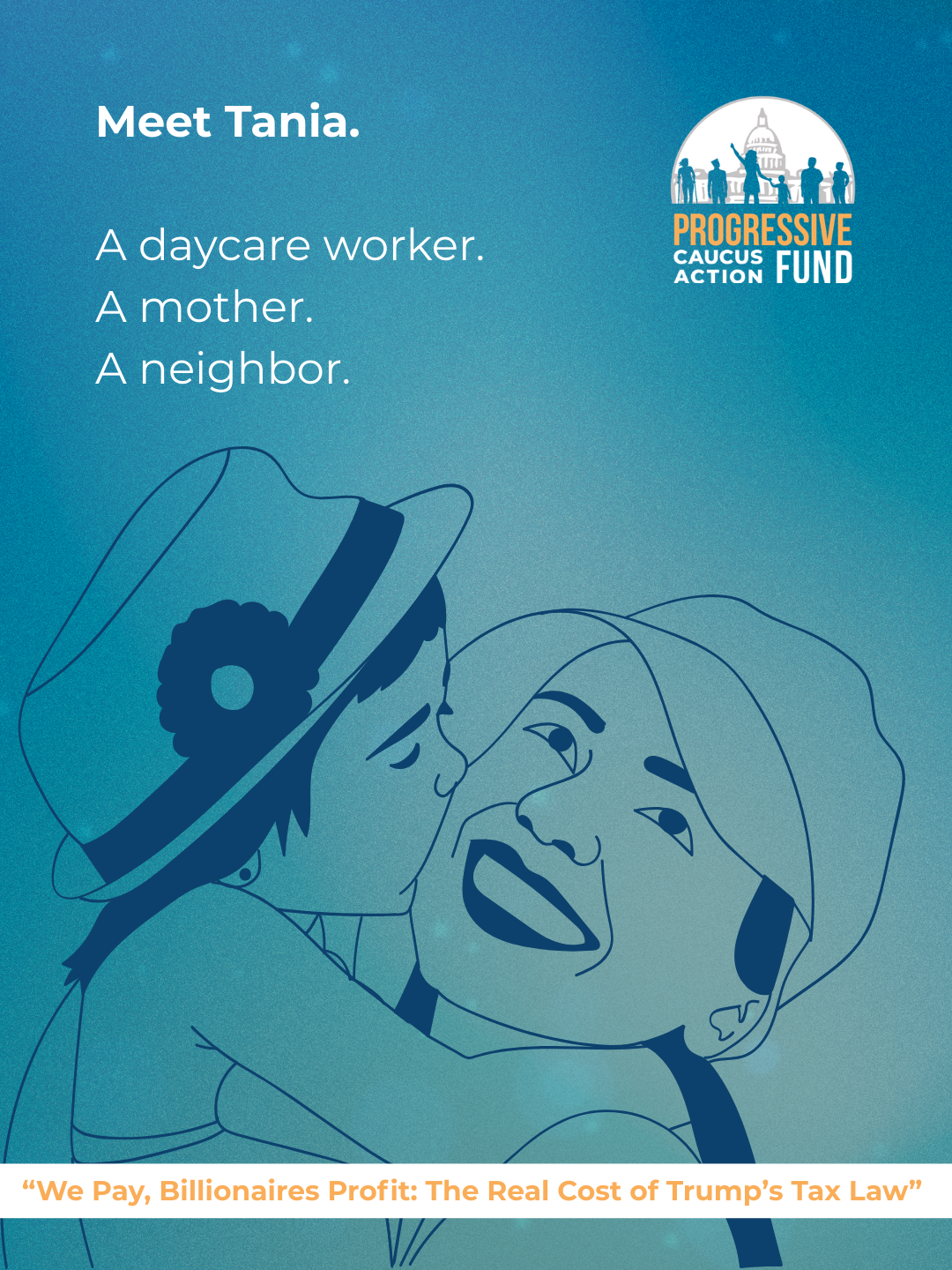
Tania, a 30-year-old single mother, lives in Minneapolis, Minnesota where she works at a daycare center. Originally from Mexico, Tania has spent nearly ten years building a life in the city, raising her daughter Mariam (11), and contributing to her community — without legal immigration status. She fled threats of violence and came to the U.S. to make a better life for her and her infant daughter, who is also undocumented. Neither Tania nor Mariam currently qualifies for a legal pathway to citizenship. Tania missed the one-year deadline to apply for asylum when she first arrived because she couldn’t find legal help in time.
Last month, ICE agents stopped Tania and Mariam while they were driving home from the grocery store and arrested them. Tania has no criminal record and is a beloved member of her community, but agents violently grabbed them, leaving her car in the street, still running, with groceries still inside. The arrest traumatized both Tania and eleven-year-old Mariam.
Since the arrest, ICE has detained Tania and Mariam at the Dilley Immigration Processing Center in Texas. The government is now placing them in expedited removal proceedings, denying them the opportunity to present their case before an immigration judge.
While being held in a penitentiary dorm at Dilley, Mariam’s health has begun to deteriorate due to malnourishment. Meanwhile, Tania — who was badly cut while being physically assaulted by an ICE agent during her arrest — has yet to receive any medical care, and her wound has become infected. The agents at the facility have only offered them one way out of indefinite detention: give up on their case and voluntarily leave the country.
ICE used federal taxpayer dollars to arrest, transport, detain, and now attempt to deport a working mother and her child — despite no criminal charges and no public safety threat. Tania and Mariam’s detention show exactly how this law spends taxpayer dollars: not to strengthen communities, but to attack working families, traumatize children, criminalize poverty, and expand a massive, dangerous, and costly federal enforcement system.
How is Tania impacted by the Republican budget law?
Tania and Mariam have been forcibly removed from their community as part of the surge of ICE activity in Minnesota, directly fueled by the massive funding increase in the Republican budget law. They now face an uncertain future and are subject to indefinite family detention, in violation of the Flores settlement.
Why? The Republican budget law granted ICE a 365% budget increase, including $45 billion for more detention capacity, $30 billion for more immigration enforcement agents, $75 billion for more border enforcement and surveillance, and $13.5 billion to expand coordination with local law enforcement. As a result of this windfall, ICE is now the largest law enforcement agency in the United States, with a larger budget than the militaries of many countries, including Poland, Italy, and Canada.
Tania and Mariam are facing severe and dangerous conditions in detention.
Why? In 2025, 32 people were reported to have died in ICE custody — nearly a 200% increase from the year prior — which makes the conditions now worse than they were during the COVID-19 pandemic.
Dire and inhumane conditions have been reported at facilities like Dilley. This includes severe overcrowding that forces dozens of people to sleep head-to-toe on concrete floors and share a single toilet. Food is restricted, with people who are detained receiving as little as a cup of water and rice per day. When more food is provided, it is often rotten, filled with bugs, or mostly frozen.
Medical neglect is widespread. People who are detained often go days or weeks without medical care, resulting in severe infections, untreated conditions, and preventable deaths.
The ACLU has detailed accounts of violent assaults by ICE agents, including sexual abuse at the Fort Bliss facility. In just 50 days, staff committed 60 violations of federal detention standards within the facility.
The harm extends beyond Tania and Mariam.
Why? Their detention also destabilized the Minneapolis community they were part of. Tania’s daycare lost a trusted worker without warning in an already understaffed sector. Mariam’s school lost a student who had been learning, building friendships, and planning a future in the community she grew up in. Some of Tania’s coworkers and Miriam’s classmates have stopped showing up out of fear they will also be abducted. At the community level, the Republican budget law’s investments in mass detention and deportation shrink local tax bases, harm local economies, and shift public dollars away from schools, healthcare, food aid and programs our families count on.
ANGELA, Louisiana
Angela is a 45-year-old waitress at a diner in Lafayette, Louisiana, and is active in her church. She is a single mother to Michele, 19, and Mary, 5. Because Angela is a tipped worker, her employer is only required to pay her $2.13 an hour (with tips bringing her wages up to at least the federal minimum wage of $7.25 an hour — when business is good). Angela works as many shifts as she can but still struggles to make ends meet, especially while helping her daughter Michele pay for community college. Michele is hoping to be a nurse practitioner someday and she was counting on using the Pay As You Earn (PAYE) program to pay back her student loans at an affordable rate while she gets her career started. Michele also works part-time at Starbucks and relies on SNAP food assistance for groceries.
How is Angela impacted by the Republican budget law?
Even though she works full-time and often picks up extra shifts, Angela won’t benefit from the law’s tax deductions for tips or overtime pay.
Why? The law provides a non-refundable tax credit for tipped and overtime wages that only benefits workers who earn enough to have a tax liability. Despite regularly working more than 40 hours a week, Angela is one of the more than one third of tipped workers whose wages are so low that they won’t receive any benefit from this new credit.
Angela’s daughter, Michele, will have to pay more for her student loans.
Why? The Pay As You Earn (PAYE) and many other income-based repayment options for student loans were eliminated in the Republican Budget law.
The law will kick Michele off of food assistance.
Why? Michele works part time at a local Starbucks but can’t consistently get many hours or control her schedule. The Republican budget law imposes new restrictions on SNAP food assistance that require her to prove she’s working a minimum of 20 hours per week to stay eligible. She can’t consistently get 20 hours a week of work so she’ll be kicked off of food assistance.
The law burdens working families while denying them relief.
Why? The Republican budget intentionally excludes low-wage workers like Angela from meaningful support or relief. The law shifts health care, food, and educational costs onto families who are already struggling and prevents them from accessing its touted benefits. This law reduces economic stability and opportunity to pay for tax breaks for the rich and significant funding increases for ICE. Despite some politicians’ claims, the law significantly harms working families.
OMER & AMINA, Texas
Omer and Amina are a married couple in their 30s from Euless, Texas. They fled the civil war in Sudan in January, 2025 and entered the U.S. as refugees after extensive vetting and years of waiting in an internally displaced persons camp. As refugees, they have a pathway to green cards but face delays in receiving their permanent status. Their three year old daughter Rania was born in the camp and suffered severe complications from malnutrition as a baby. Today, she needs complex and expensive healthcare.
Both Omer and Amina work long hours. Amina was a pharmacist in Sudan and Omer worked as an engineer but they’ll need to go back to school in order to work in their fields in the U.S. Currently, Amina is working as a hotel cleaner and Omer found a job in construction. In order to make ends meet and ensure that Rania has the care she needs, they rely on SNAP, Medicaid, and the Children’s Health Assistance Program (CHIP) for food and health coverage. They are hoping to adjust their status to Legal Permanent Residents as soon as they can but the Trump administration’s pause on refugee applications and adjustments of status means they can’t move forward.
How are Omer and Amina impacted by the Republican budget law?
Their family no longer qualifies for SNAP, and will lose access to Medicaid and CHIP in October. Without these benefits, they’ll be forced to choose between rent and food while also no longer being able to access doctors or the in-home health aid that Rania needs.
Why? The Republican budget law cut many categories of legal immigrants from benefits like SNAP, CHIP, and Medicaid, including refugees, asylees, survivors of trafficking, and more.
They will lose out on the enhanced Child Tax Credit.
Why? The Republican budget law keeps many immigrants and mixed-status families from receiving the Child Tax Credit and other deductions, even if they are here lawfully or otherwise eligible. For example, if neither parent has a Social Security number, they cannot claim the Child Tax Credit even if the children are U.S. citizens.
They are living in fear that they might face detainment or deportation even though they have legal status and the right to work.
Why? The Trump administration’s increasingly violent immigration enforcement is also affecting legal immigrants. Many refugees and asylees have been stopped, harassed or even detained. Other families with active asylum cases are illegally facing deportation and detention including Adrian Alexander Conejo Arias, father of 5-year old Liam Conejo.
The Trump administration paused adjustment of status for refugees, stopped processing refugee applications, and is reviewing all refugees who arrived between January 21, 2021 and February 20, 2025. In February 2026, the administration granted ICE broad authority to detain refugees who entered the U.S. legally but do not yet have green cards. The prospect of being re-interviewed is terrifying for Amina and Omer and will force them to relive traumatic experiences. Since the new policy was announced, Amina has had nightmares and trouble sleeping. In addition, many members of their family are still waiting to get to safety in refugee camps.
SAMANTHA, Nebraska
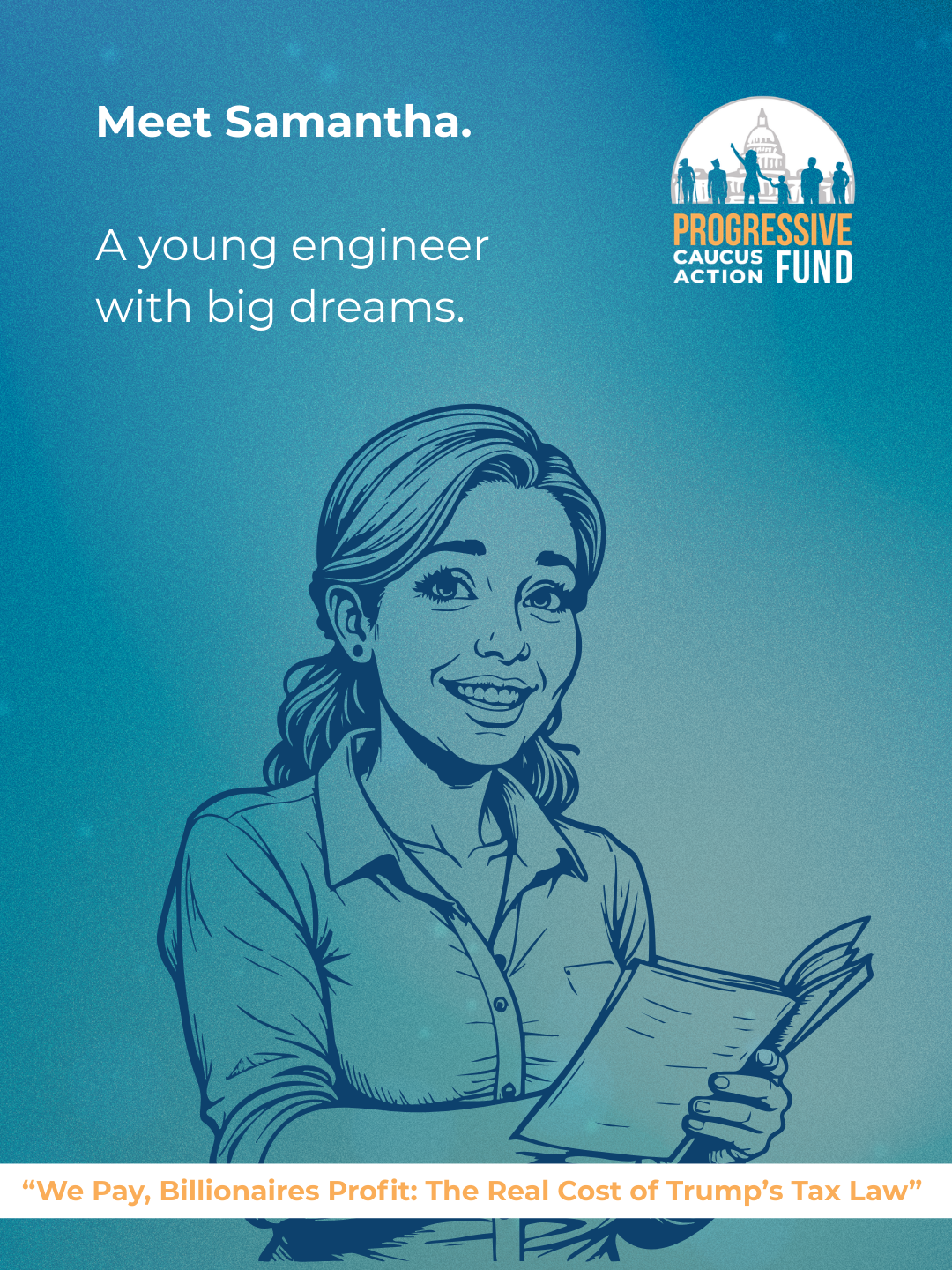
Samantha is a 27-year-old electrical engineer who recently graduated with a master’s degree in engineering. She is the first in her family to attend college and she has about $120,000 in student debt from both her undergraduate and graduate school loans.
She had a great job with the South Sioux City, Nebraska municipal government, earning $85,000 per year as the lead engineer on a new 2.3-megawatt solar farm project. The project would have provided about 5 percent of the city’s total electricity needs on land the city already owned, but at the last minute the funds that were supposed to finance it were withdrawn by the Trump administration's elimination of the Solar for All program.
Samantha’s now working as a freelance engineer while the city looks for replacement funding. She’s getting by for now, but her income is unstable and she worries about making ends meet.
How is Samantha impacted by the Republican budget law?
Her health care premiums will rise sharply, putting her at risk of losing coverage.
Why? Samantha previously qualified for Affordable Care Act (ACA) premium tax credits that kept her coverage more affordable. Under the Republican budget law, those subsidies were not renewed, meaning she now faces a 75 percent increase in her health insurance premiums that she cannot afford. On her freelance income, Samantha is likely to drop her health coverage entirely, leaving her uninsured. This not only jeopardizes her own access to care but also, as more people become uninsured, the law will destabilize the ACA insurance pool and drive costs higher over time for everyone.
She will owe significantly more on her student loans.
Why? The Republican budget law eliminated the SAVE repayment program, which capped monthly payments and forgiven remaining debt after a set period. At the same time, the Trump administration restarted interest charges on federal loans that had previously been paused. As a current borrower, Samantha will be switched over to an Income-Based Repayment (IBR) plan that will cost her an additional $3,425 per year.
The clean energy job she trained for and counted on was cut.
Why? South Sioux City was relying on Solar for All grants — part of the Inflation Reduction Act’s Greenhouse Gas Reduction Fund — to finance the community solar project. The Republican budget law eliminated the program, which cut about 90 percent of allocated funds and impacted projects across the country. The Republican budget law’s cuts are hurting clean energy workers, communities, and local governments across the country.
The law restricts innovation and growth.
Why? The Republican budget law removes critical supports that young professionals like Samantha count on to build a stable career. By eliminating ACA subsidies, it makes her health coverage unaffordable, risking her health and financial stability and weakening the broader insurance pool. By canceling funding for her city’s solar project, it derails a forward-looking clean energy initiative that would have provided local jobs, lowered energy costs, and advanced environmental goals. By making it harder to access public student loans, it deters young people from pursuing high-skill, in-demand fields. These changes stack short-term costs on young adults and limit the development of a skilled, innovative workforce.
JOHN & NATALIE, Washington
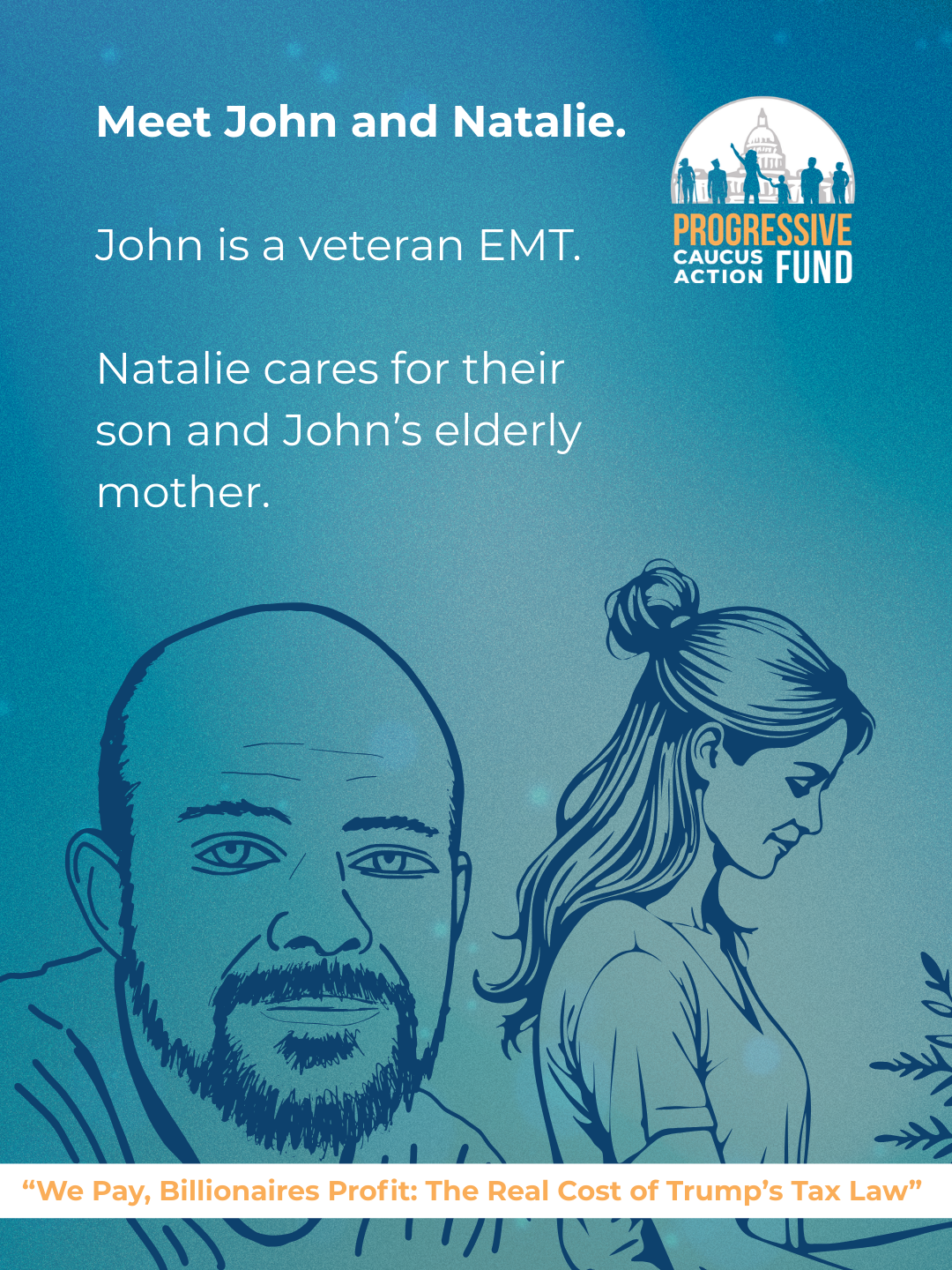
John and Natalie are a married couple in their 40s living in Forks, Washington with their 10-year-old son, Nathan, and John’s 70-year-old mother, Sue. John was raised in Forks, and his son attends the same school he once did. He served in the marine corps for 20 years and now works long, irregular hours as one of the town’s Emergency Medical Technicians for the Forks Community Hospital, earning about $22 per hour, or roughly $62,500 per year. He’s also a volunteer fire fighter. Natalie left the paid workforce to provide full-time care for her son and mother-in-law Sue, who recently moved in as her health has worsened. Nathan has chronic asthma and sometimes needs emergency medical attention. Sue is disabled and relies on Medicare and Medicaid, which covers the long-term home-based services that allow her to live with her family.
John’s modest income, the loss of Natalie’s wages, and the cost of managing chronic illness have put a strain on their finances and their marriage. They use SNAP food assistance to supplement their grocery bills. They are active members of their local community and volunteer with their local food bank as often as they can. Natalie worries if their costs rise more, they might need to rely on the food bank themselves.
How are John and Natalie impacted by the Republican budget law?
Their local hospital is at risk of closing, putting the family’s livelihood and access to care in jeopardy.
Why? The Republican budget law significantly cuts funding for rural hospitals by reducing payments and supports these facilities rely on to stay open. As a result, Forks Community Hospital — one of six rural hospitals at risk of closure in Washington alone — may close, leaving John without a job and their family 71 miles from the nearest hospital if Nathan has a severe asthma attack or Sue needs urgent medical care. Delayed care could be life-threatening.
Nathan’s asthma will continue to be worsened by air pollution from diesel buses.
Why? Nathan’s school district had planned to replace aging diesel buses with a new fleet of electric buses that are quieter and fume-free. They had planned to apply for the 45W clean commercial vehicles tax credit through Direct Pay, which would have provided up to $40,000 per bus. However, they were not able to purchase them before the September 2025 deadline when the credit was eliminated as part of the law’s gutting of clean energy tax credits and programs. The Republican budget law will force Nathan and his classmates to continue breathing diesel fumes on the way to school, putting them at increased risk of asthma attacks and other serious illnesses.
Sue risks losing her Medicaid benefits due to funding cuts and new administrative barriers.
Why? The Republican budget law imposes new work documentation and reporting requirements for Medicaid eligibility, even for retirees. Because the law requires frequent paperwork updates and strict compliance, Sue must repeatedly file complicated forms and risks losing her coverage if she makes any mistakes or can’t keep up with her paperwork.
The law’s deep cuts to Medicaid also threaten Sue’s access to services, shifting costs and caregiving responsibilities onto families like John and Natalie’s. If Sue loses coverage of needed services, Natalie will have to provide even more unpaid care. They will also now be on the hook for an additional charge of up to $35 per health care service which could result in thousands of dollars in new out-of-pocket medical expenses each year.
They will receive a larger Child Tax Credit and a larger standard deduction, but not enough to cover their rising costs.
Why? The Republican budget law increased the CTC from $2,000 to $2,200 per child for some families, providing their household a modest tax break. The law increased the standard deduction for married couples filing jointly from $29,200 to $31,500, which they qualify for because their household income is under $150,000. However, these limited tax benefits do not offset the rising costs of healthcare worsened by the law.
The law makes it harder to keep their SNAP benefits and is putting a strain on their local food bank.
Why? As a veteran, John qualified for reduced paperwork requirements when he applied for SNAP food assistance but the Republican budget law eliminated that exemption. John and his family will still qualify for assistance, but the law makes it harder for them to prove it and access the benefits. As other families in Forks struggle with rising food costs from tariffs and benefits cuts, the food bank the family volunteers for is struggling to keep up with the need.
The law undermines family stability in rural communities.
Why? Health care and caregiving are deeply interconnected, and when one part fails, families are forced to fill the gap. The Republican budget law’s severe cuts to Medicaid threaten services that older adults, people with disabilities, and their families and caregivers count on. As rural hospitals and clinics face closure or cutbacks, emergency response times increase, health outcomes worsen, and first responders like John are asked to do more with fewer resources. Family members – most often women — are pushed out of the paid workforce to provide unpaid care, reducing household income and shrinking the local workforce. These budget cuts have financial and emotional repercussions for working families, creating exhaustion, confusion, and fear. The Republican budget law weakens rural economies and leaves entire regions more vulnerable.
STEVE & HILARY, Connecticut
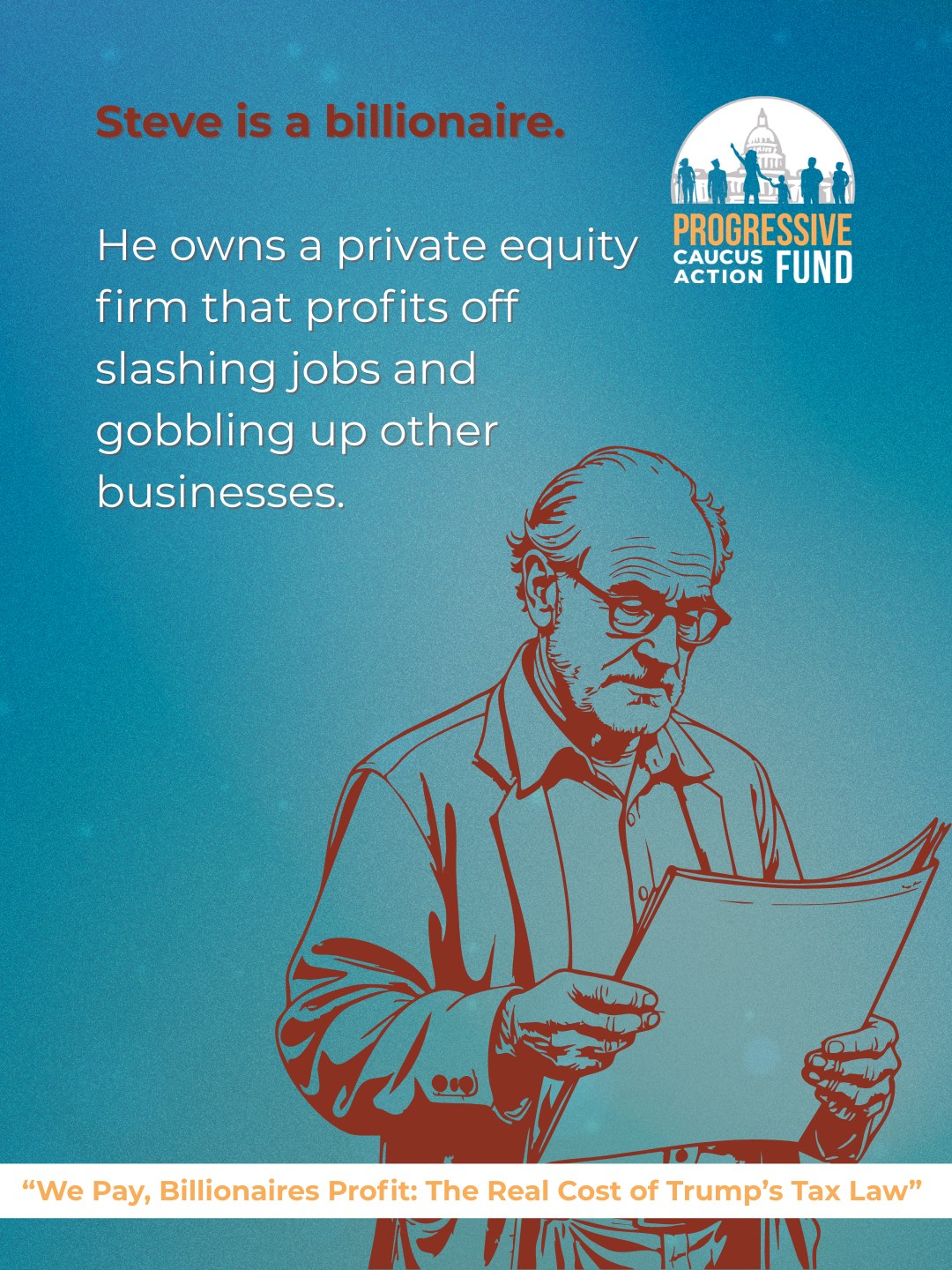
Steve and Hilary are a married couple in their 60s living in Greenwich, Connecticut. Steve is a billionaire who leveraged loans from his wealthy parents to amass a fortune as the founder and managing partner of a private equity investment firm. His income has come largely from leveraging debt and selling off the businesses he buys, often cutting jobs and bankrupting the original businesses in the process.
They have two adult children, Steve Jr. and Greg, who are both lawyers. Steve Jr. is now counsel for his father’s business, and together they work with outside tax and estate planning professionals to manage the family’s finances. Steve has a large real estate portfolio, including several rental properties in lower-income areas of the state, as well as two vacation homes. His son Greg, after working in corporate law, followed his father into private investment and now works at a firm specializing in oil and gas ventures. Like his father, Greg’s income comes primarily from investments rather than wages.
How are Steve and Hilary impacted by the Republican budget law?
They can transfer tens of millions of dollars to their children without paying any estate taxes.
Why? For married couples filing jointly, the Republican budget law increases the amount that can be passed down before the estate tax applies to $30 million (up from roughly $27 million in 2024). They can pass tens of millions of dollars onto their already wealthy sons without paying a penny of estate tax.
Because Steve’s wealth is held largely in his business and real estate, the family can further reduce the tax they pay through trusts and estate planning strategies commonly used by wealthy households.
The estate tax cuts — welfare for the wealthy — are estimated to cost $212 billion over the next ten years, more than the $187 billion in cuts to SNAP that will harm roughly 4 million people. In other words, millions of households that rely on food assistance to meet basic needs will lose this support so that a small number of wealthy families can pass millions more dollars to their adult children tax-free.
Steve’s businesses continue to pay historically low tax rates.
Why? The Republican budget law permanently extends the corporate tax cuts enacted in 2017 under the first Trump administration. The top corporate tax rate is now 21 percent, down from 35 percent prior to 2017 (the historic high was 52.8% in 1968). This corporate tax cut alone will cost $752 billion over the next decade, lining the pockets of mega corporations and shareholders. For context, tuition-free college for families making less than $125,000 per year would cost a comparable $800 billion over 11 years.
Steve’s business, which generates profits through investment activity, will benefit from reduced tax liability year after year while working people keep paying fixed tax rates on their wages. In order to pay for corporate tax giveaways, the Republican budget law slashed healthcare, food aid, and more.
Steve will continue to benefit from a pass-through deduction on his business income.
Why? Steve’s investments and real estate business qualify for an additional 20 percent Section 199A pass-through deduction, which allows certain business owners to reduce their personal tax income liability on business income. This deduction was set to expire in 2025, but the Republican tax law made them permanent.
Over the next ten years, this pass-through deduction will cost $737 billion; eighty-seven percent of these deductions will benefit the top 10 percent of earners, while households making less than $200,000 (roughly 60 percent of filers) will receive just 11 percent.
Steve does not have to pay capital gains taxes on portions of his business investments.
Why? Federal tax exclusions allow founders and investors of so-called “small businesses” — defined as companies earning up to $75 million a year — to exclude capital gains taxes on qualifying stock sales. These Qualified Small Business Stock (QSBS) exemptions significantly reduce taxes for investors with large stock holdings. QSBS exemptions cost taxpayers $17 billion over ten years, with 75 percent of the benefits going to those making $1 million or more per year and only one percent going to those making less than $100,000.
Steve’s real estate business continues to receive tax cuts for buying up housing in low-income areas.
Why? Because Steve is buying housing in government-identified “opportunity zones,” he qualifies for additional tax cuts that give him more money to invest. These “opportunity zones” are supposed to encourage investment and development in underserved areas, but in practice people like Steve can buy up affordable housing, raise rents, and pocket the profits, rather than creating new affordable housing or helping these communities grow.
The Republican budget law extended the expiring Opportunity Zone exemption, which will cost $41 billion over the next 10 years.
Additionally, the tax law allows investors like Steve to claim a 100 percent bonus depreciation tax cut for these investments, allowing them to immediately write off the full cost of certain real estate purchases.
Steve’s son Greg also gets a huge tax advantage on his oil and gas investments.
Why? Steve’s son Greg benefits from the Republican budget law’s expanded tax giveaways to oil and gas production that promote the drilling and extraction of fossil fuels. The law rewards the fossil fuel developers who are fueling the climate crisis with a tax break while slashing investments in clean and renewable energy.
The law spends public dollars to promote private wealth.
Why? The consequences of the Republican budget law extend far beyond lining the pockets of the megarich like Steve. By directing hundreds of billions of taxpayer dollars to estate tax cuts, corporate rate reductions, business pass-through deductions, and fossil fuel incentives, the law spends substantial public resources on preserving and growing private wealth at the very top rather than on effective, equitable promotion of public goods. These are deliberate policy choices about how shared federal revenue is used. Every dollar spent reducing taxes for wealthy investors is a dollar cut from health care, food assistance, education, housing, or clean energy investments. Under this law, taxpayer dollars are being directed toward those who already have the most, rather than public investments that promote economic opportunity and growth.
—
These profiles are composites that draw from real stories of the economic and policy impacts of the Republican budget law and do not represent any single individual or family. Stories like these are playing out across the country this tax season.